IAM is about defining and managing the roles and access permissions of individual users of IT systems. These users can be customers, employees, contractors, students, etc. IT systems are typically heterogeneous and accessible over an internal network, but sometimes certain segments are also exposed to the Internet. This makes it all the more necessary to pay careful attention to access control – Identity and Access Management.
Identity and Access Management tools
Identity and Access Management consists of Identity Management (IdM) and Access Management (AM)
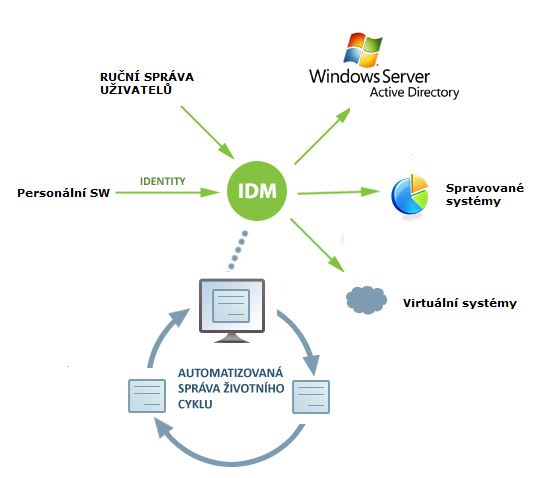
Identity Management (IdM) is the centralized management of identities in IT systems, which is provided by the Identity Manager software. It is a process tool that has a communication interface to many managed systems. Identity Manager integrates the managed systems and enables account management processes to be performed on top of them in end systems. IdM includes synchronization tools for data transfer, auditing and reporting functions, and of course a user interface that allows you to delegate responsibility for certain tasks to users.
Access Management (AM) is the processes, procedures and technologies (SW = Access Manager) used to control and monitor access to IT systems. Access management features such as authentication, authorization, trust auditing and security are integral to high-end access management systems for on-premises and cloud-based systems.
Why is Identity and Access Management important?
IAM identity and access management is inextricably linked to IT security and productivity for organizations in today’s digital age.

A compromised digital identity often serves as an entry point into an organization’s network. Organizations that use IAM to secure their information assets are better able to counter the growing threats of ransomware, hacking, phishing and other malware attacks.
In many organizations, users have more access permissions than necessary. With more privileges, a user can access data they should not have access to (e.g., payroll). An IAM system can add an important layer of protection by ensuring consistent application of user access rules and policies throughout the organization.
Central system administration can reduce the complexity and cost of securing user authentication and access. IAM systems also enable users to increase productivity (while maintaining security) in a variety of environments, whether they are working from home, the office, or on the road. Just do the math on how much it costs an organization to manually set up and maintain a single account and we come to hundreds of thousands per year. If the risk of data theft is factored into the cost, we arrive at the fact that the area of user account management is quite costly.
Benefits of IAM
Implementing IAM can provide a company with a significant competitive advantage. Today, most organizations need to provide users with access to internal systems from an external network. IAM allows an organization to extend access to its information systems across on-premise applications, mobile apps, and SaaS without compromising security. By providing access from an external network, productivity, employee satisfaction, research and development, and ultimately revenue can be increased.